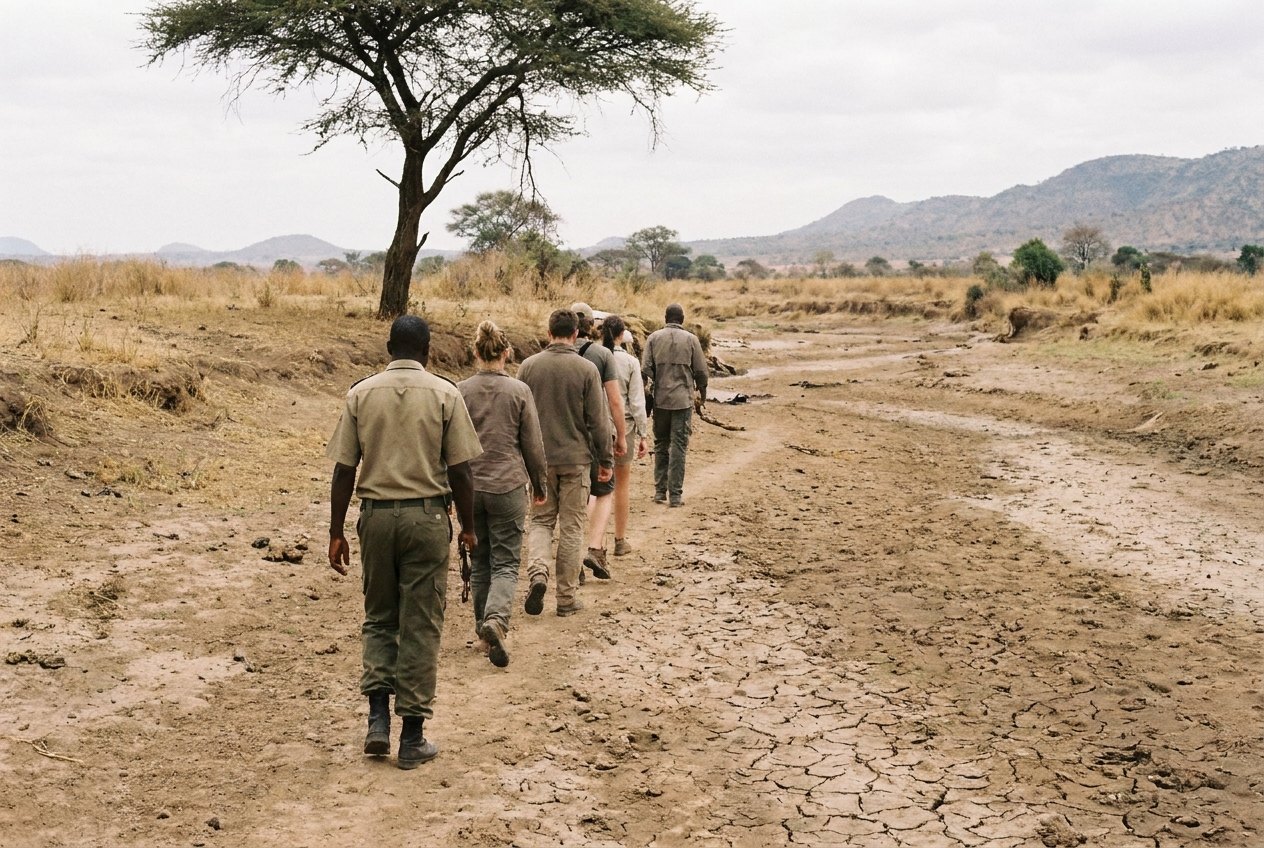
Ruaha allows walking safaris with an armed park ranger, and a walk shows you the park in a way a vehicle cannot. You hear more, smell more and notice the small details that disappear at driving speed. It is a slower, quieter way to understand the bush.
What a walk involves
Walks are led by an armed park ranger, and groups are kept small. The pace is gentle, with frequent stops. The aim is not to get close to big animals but to read the land: who passed this way, what they ate and where they went.
Most walks start in the cooler early morning, when animals are active and the heat has not yet built. In the hot months walks are usually kept short.
What you see on foot
Tracks in sand and dust are the first thing you learn to notice. Elephant footprints, lion pugmarks, the neat slots of antelope hooves and the trails of beetles and snakes all tell part of the story. Dung shows what an animal has been eating and how recently it passed.
Plants come into focus too. You see the baobabs up close, with the gouges elephants leave in the bark, and the shrubs and grasses that make up the bush. Insects, spiders and termite mounds become part of the walk, and birds are easier to hear than to see.
ALSO IN THIS GUIDESand rivers: water under the riverbedRules that keep you safe
Walking in a park with lions, elephants and buffalo carries real risk, and the rules exist for good reason. Listen to the ranger's briefing before you set off and follow every instruction.
- Walk in single file behind the ranger and keep the group together.
- Keep quiet, and speak in a low voice when you need to.
- Never run, whatever you see. Running can trigger a chase.
- If the ranger stops or signals, stop and wait for the next instruction.
- Never approach, feed or call to any animal.
What to wear and carry
Wear neutral colours such as khaki, olive, brown or grey. Bright colours stand out, and dark blue and black can attract tsetse flies. Closed walking shoes and long trousers protect against thorns and insects. A hat, sunscreen and water are essential, and binoculars help you see animals at a safe distance.
A walk fits well into a longer stay in the park. Many people combine morning walks with game drives along the Great Ruaha River later in the day, when animals gather at the water. The best time for walking is usually the dry season, when the grass is short and visibility is good.
Photographers and licences are listed on whose pictures these are.