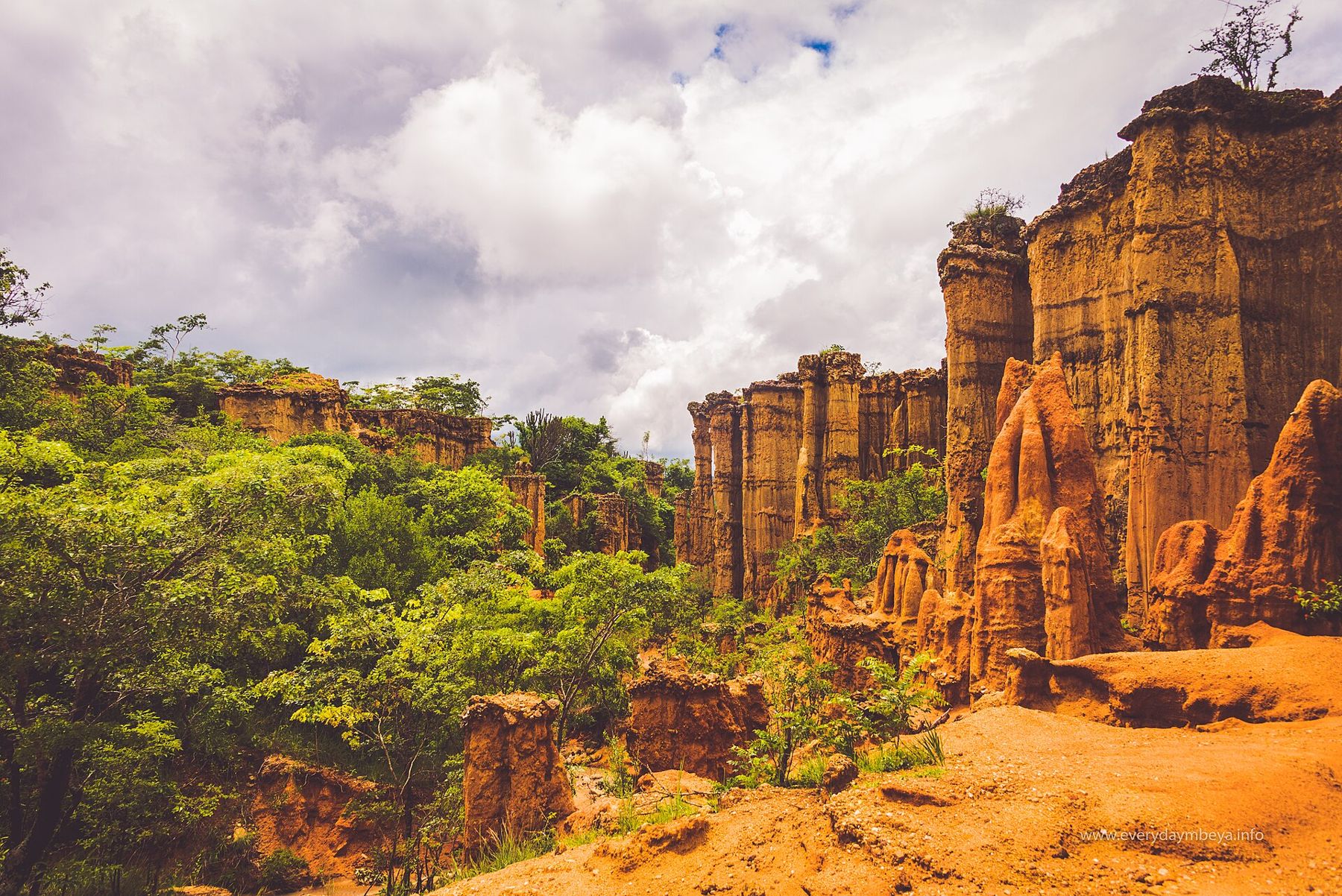
A gully full of history
Isimila lies about 20 km south-west of Iringa, a short turn off the main road to Mbeya. At first sight it is a landscape feature: a gully where rain and erosion have cut through soft sandstone, leaving tall pillars and columns standing in shades of cream, orange and red. Look more closely and it is also one of the better-known Stone Age sites in East Africa.
The stone tools
In the 1950s, archaeologists excavated Isimila and found large numbers of stone tools. Many belong to the Acheulean tradition, the long-lasting way of making tools that is known for its hand axes and cleavers. A hand axe is a large stone shaped on both faces into a pointed, teardrop form; a cleaver has a broad, straight cutting edge. These tools were used for cutting, chopping and butchering, and were made by early humans over a very long span of time across Africa and beyond.
Making a good hand axe took skill and planning. The maker had to choose the right stone, strike off large flakes in the right order, and then shape both faces into a balanced tool. Finding so many of them in one place tells archaeologists that people came back to this spot again and again.
The age of the Isimila tools has been debated, and different methods have produced different figures. What is safe to say is that they are very old, tens of thousands of years at least, and possibly much older. The site preserves the work of people who lived here long before any written history of the region.
ALSO IN THIS GUIDEIringa, the town on the escarpmentWhat you see today
A small museum near the entrance displays tools found at the site and explains how they were made and used. Seeing them laid out helps you recognise the shapes of hand axes and cleavers, and understand why such ordinary-looking stones matter so much to archaeologists.
From the museum, a short walk leads down into the gully among the sandstone pillars. Paths can be uneven, and the sun reflects strongly off the pale rock in the middle of the day, so wear sturdy shoes, carry water and go in the morning or later afternoon if you can. Leave any stones and tools exactly where you find them.
Fitting Isimila into a trip
Isimila is easy to combine with other places near Iringa. Many visitors pair it with Kalenga and the Mkwawa museum, or stop on the way to or from Ruaha National Park. An hour or two is usually enough for the museum and the walk.
The site is best in the dry season, when the paths are firm. In heavy rain, the gully can be muddy and slippery. The pillars themselves are fragile: they are made of soft rock that erodes a little every rainy season, so do not climb on them or carve into them. Stay on the paths, take your rubbish away with you, and give the place the care it needs to last for the next visitors.
Photographers and licences are listed on whose pictures these are.