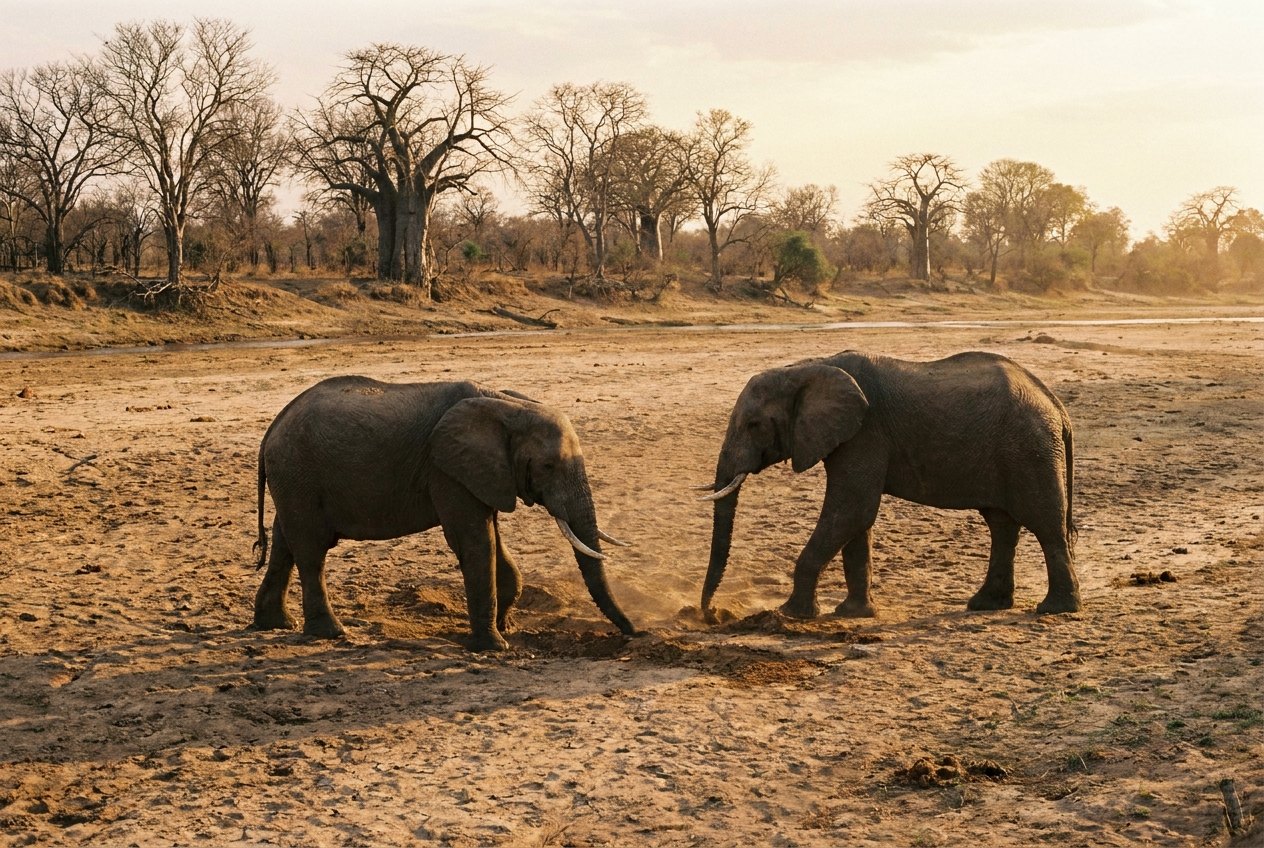
Ruaha's sand rivers are some of the most striking features of the park. The Mwagusi, the Mdonya and several others flow only during the rains, when they can run fast and deep. For the rest of the year they look like broad roads of pale sand winding through the bush, lined with trees whose roots reach down to water that never quite disappears.
Water below the sand
When the rains end, the surface flow stops, but water keeps moving slowly beneath the riverbed. The sand acts as a cover, slowing evaporation and keeping a store of water within reach of anything able to dig for it. That makes the sand rivers vital in the dry months, especially when the Great Ruaha itself has shrunk to pools.
Elephants as well-diggers
Elephants are the main diggers. They scrape into the sand with their feet and trunks until water seeps into the hole, then drink the clean water that collects. Watching an elephant work at a hole can take a while, as the water fills slowly and the elephant waits.
Once the elephants move on, other animals use the holes. Baboons, impala, kudu and birds come to drink from water they could not reach on their own. In this way the elephants of Ruaha keep water available for much of the park's wildlife through the driest weeks.
ALSO IN THIS GUIDEBaobabs and how elephants shape themCorridors for animals and vehicles
Because the beds are open and the banks are wooded, sand rivers make natural corridors. Animals use them to move through thick bush, and game drives follow their courses for the same reason. Vehicles cross them on drifts, the low points where the track dips down into the riverbed and climbs out on the far side. After heavy rain some crossings become impassable for a time.
The banks also suit predators. Lions often rest in the shade of riverbed trees, and the steep sides and thick cover make good places for an ambush when prey comes down to drink. Leopards use the trees along the banks too. Sightings are never guaranteed, but a sand river in the late dry season is one of the better places to wait.
Watching a sand river well
Choose a spot with a clear view of a stretch of riverbed, ideally near fresh digging, and give the animals space. Stay in the vehicle unless a ranger says otherwise. Never drive into the riverbed close to animals at a water hole, and never feed anything. Morning and late afternoon bring more movement, while the middle of the day is quieter and much hotter.
The sand rivers change through the year. In the green season they may carry water and some tracks along them close; by the end of the dry season they are the centre of activity.
Photographers and licences are listed on whose pictures these are.