Where two regions meet
Ruaha National Park sits on a meeting line. Its drier acacia and commiphora bush belongs to East Africa, while the miombo woodland on its higher ground is typical of Southern Africa. Animals from both regions live here, and that is especially clear among the antelope. Ruaha is one of the few parks where you can see both greater and lesser kudu, and in the woodland you may also find sable and roan.
Two kinds of kudu
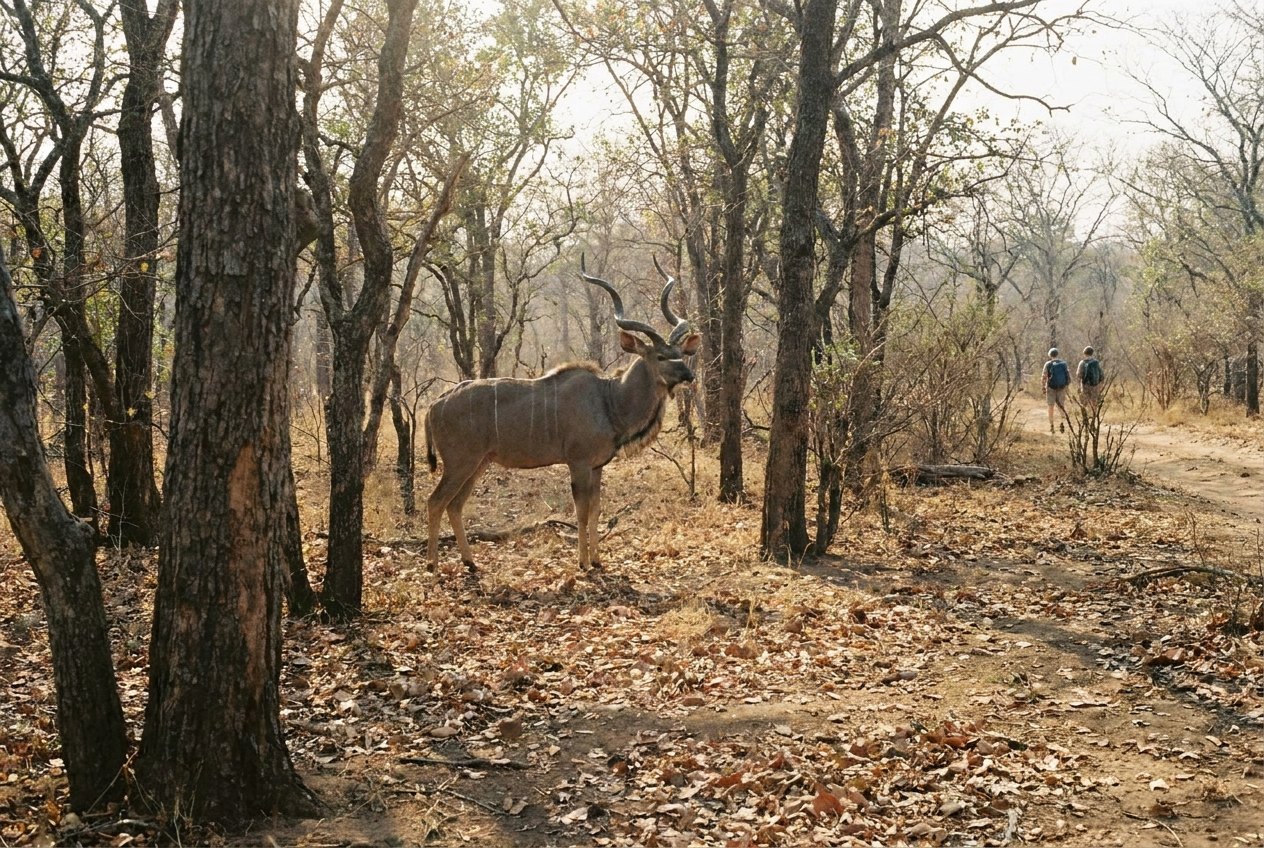
The greater kudu is a big, grey-brown antelope with thin white stripes down its sides. Males carry long spiralling horns, often with two and a half twists, and a fringe of hair along the throat. They browse in thicket and along wooded slopes, and often stand still in cover, which makes them easy to miss.
The lesser kudu is smaller and more slender, with more white stripes on its body and two white patches on the throat. Males have shorter horns that are still clearly spiralled. Lesser kudu like dense, dry bush and are shy, so a good view is something to treasure.
A quick way to tell them apart: size, the number of body stripes, and the throat. Greater kudu bulls have a fringe of hair under the throat; lesser kudu have two clear white throat patches.
ALSO IN THIS GUIDELions, wild dogs and the other hunters of RuahaSable and roan in the miombo
Sable antelope are dark and handsome. Adult males are glossy black or near-black with a white belly and bold white face markings, and carry long, backward-curving horns. Females and young are browner. Roan antelope are larger, greyish or reddish brown, with a black and white face mask, long tufted ears and shorter, curved horns.
Both live in the miombo woodland, usually in small herds, and both need grass and water within reach. They are not seen on every drive. Their woodland is less often driven than the river roads, so a visit to the miombo country gives you the best chance.
The rest of the herd list
The common animals are worth time too, and they are often the best place to learn how antelope behave: who watches, who feeds, and how a herd reacts to danger. Impala are everywhere near water. Grant's gazelle, an East African species, lives in the more open country. Eland, the largest antelope, moves in herds through the bush. Plains zebra, giraffe and buffalo complete the picture, and they all bring the predators with them.
In the dry season, many of these animals gather at the Great Ruaha River and at holes that elephants dig in the sand rivers. Watch from the vehicle, keep your distance, switch the engine off when you stop, and never feed any animal. Antelope that are calm will often carry on feeding, which gives you the best chance to study the details: horns, stripes and faces. For more on timing, see the seasons.
Photographers and licences are listed on whose pictures these are.