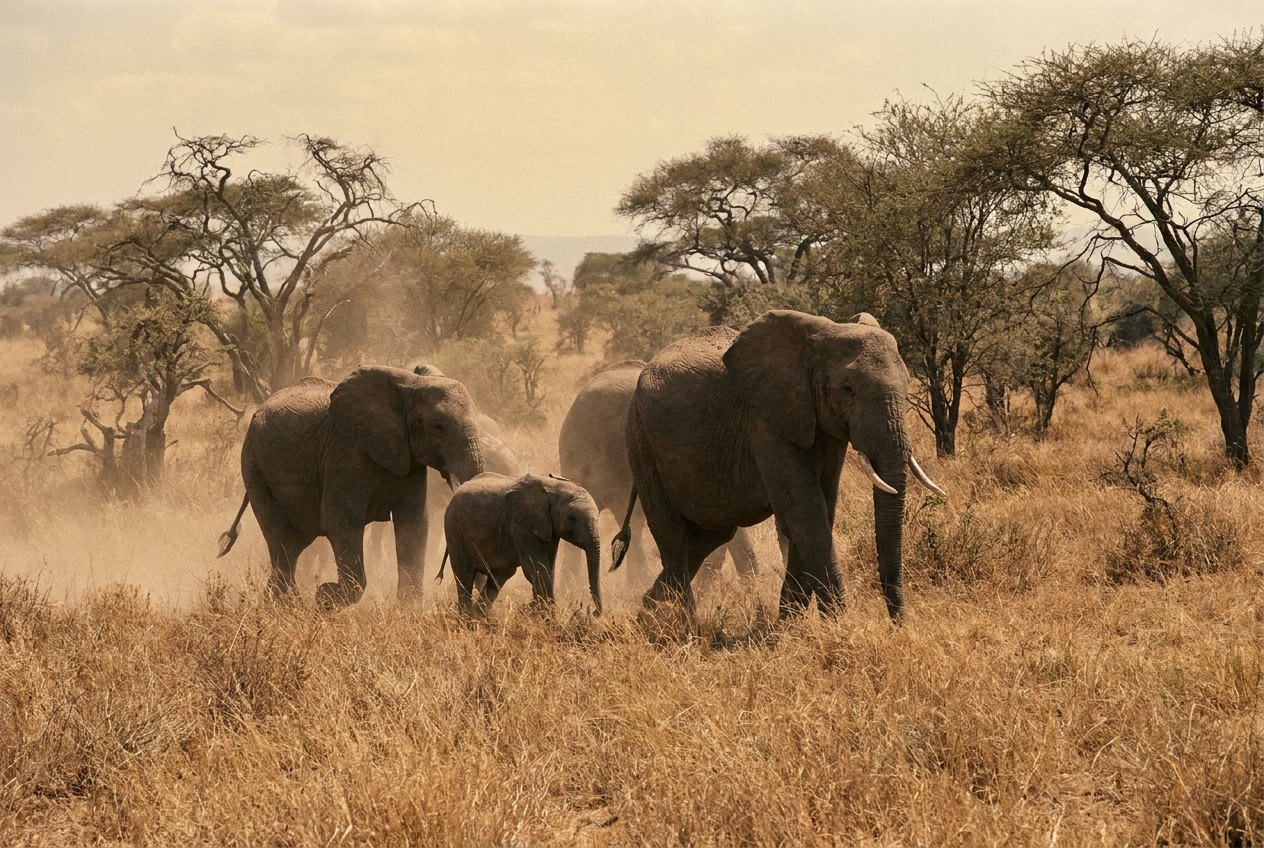
Elephant country
The Ruaha-Rungwa ecosystem, which takes in Ruaha National Park and the reserves around it, has long held one of the largest elephant populations in East Africa. Drive the park roads in the dry months and you rarely go long without seeing a herd: family groups led by an older female, young bulls drifting at the edges, and big solitary males moving slowly between water and shade.
The elephants here live in a hard landscape. The rains are short, the dry season is long and hot, and much of the water disappears from the surface for months. How the herds get through that dry season shapes nearly everything you will see them do.
Digging for water
When the seasonal rivers stop flowing, water often remains below the sand. Elephants find it. They kick and scoop at the riverbed with their feet and trunks until a hole fills with clean water, then drink. Once an elephant has opened a hole, other animals follow: baboons, impala, kudu and birds all use the same water when the elephants move on. In the sand rivers such as the Mwagusi, a line of dug holes along the riverbed is one of the clearest signs of the season.
Closer to the park headquarters, herds come down to the Great Ruaha itself, crossing the channels and drinking from the pools that remain as the river shrinks.
ALSO IN THIS GUIDEThe Great Ruaha in the dry monthsBark, wood and baobabs
In the dry season grass is scarce, and elephants turn to woody food. They strip bark, break branches and push over smaller trees. Their most visible work is on the baobabs of the lower country: elephants gouge into the soft, water-holding wood of the trunks, leaving deep scars and hollows. Many old baobabs in Ruaha carry these marks, some of them very old.
Losses and recovery
The herds of Ruaha have not had an easy recent history. Poaching for ivory rose sharply in the late 2000s and early 2010s, and surveys of the wider Ruaha-Rungwa ecosystem recorded a large fall in elephant numbers between 2009 and 2014. Protection has since improved, with more patrols and closer attention from the park authority, but the losses were heavy and recovery in a slow-breeding animal takes time.
That history is one reason some herds can be nervous around vehicles. Give them room and they usually settle and carry on feeding.
Watching elephants safely
- Keep your distance and let the elephants decide how close they come. If an animal flaps its ears, shakes its head or turns toward you, back away slowly.
- Never place the vehicle between a mother and her calf, or between a herd and the water it is walking to.
- Stay in the vehicle unless a ranger says otherwise, and keep voices low.
- Switch the engine off when you stop, and give a herd crossing the road all the time it needs.
- Never feed any animal.
The best viewing tends to come in the second half of the dry season, when the herds concentrate near the remaining water. Early morning and late afternoon are cooler, and that is when elephants are most active at the riverbeds.
Photographers and licences are listed on whose pictures these are.