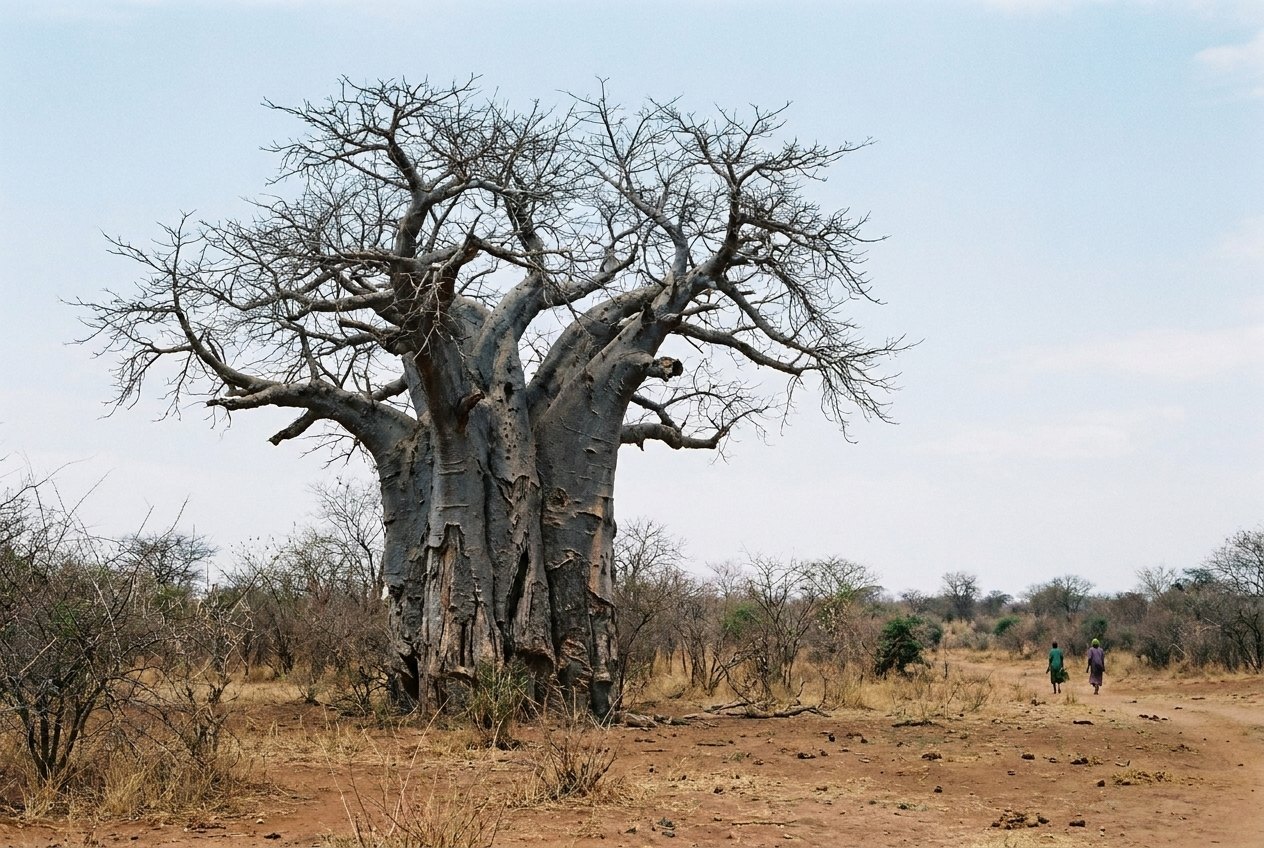
The African baobab, Adansonia digitata, is one of the defining sights of Ruaha. It is common in the park's lower, drier country, often growing on slopes above the river and the sand rivers. With its thick trunk and short, spreading branches, it is easy to pick out from far away, especially in the dry season when the rest of the bush has thinned.
A tree built to store water
The baobab's trunk is soft and fibrous, and it holds large amounts of water. This lets the tree survive long dry seasons without losing its grip on life. Baobabs shed their leaves for most of the dry season, which cuts water loss, and stand bare until the rains return. Then they leaf out again and later produce large, hanging fruits.
Baobabs can live for many centuries. Their ages are hard to measure, because they do not lay down clear growth rings the way many trees do, and old trunks are often hollow. A very large baobab may be very old indeed, but an exact age is usually a guess.
What elephants do to them
In the dry season elephants turn to baobabs for moisture and food. They use their tusks to gouge into the bark and soft wood, then strip and chew the fibres. Over the years this leaves deep scars and hollows in the trunk, and some trees end up with large chunks missing at the base.
ALSO IN THIS GUIDESand rivers: water under the riverbedBaobabs can often regrow bark over damaged areas, so many scarred trees survive. Heavy damage, though, can bring a tree down. The marks on the trunks are a record of the dry seasons the tree has lived through and of the elephants that came to it.
Food and shelter for others
The fruit holds a dry, chalky pulp that baboons eat, and other animals pick up what falls. Birds use the branches and hollows for nesting and perches, and a large baobab can host a small world of insects, lizards and bats. Its shade is welcome in the heat of the day, for animals as much as for you.
Seeing them well
Baobabs look their most dramatic in the dry season, when they stand bare against a pale sky. Low light in early morning or late afternoon brings out the texture of the bark and the gouges left by elephants. The green season changes the picture, as the trees leaf out among thickening bush; the two seasons make very different photographs.
Keep to the vehicle and the park tracks unless a ranger says otherwise. Elephants feeding at a baobab may be absorbed in the work, but they are still wild and deserve a wide berth.
Photographers and licences are listed on whose pictures these are.